
Subretinal Photovoltaic Implant to Restore Vision in Geographic Atrophy Due to AMD
TL;DR
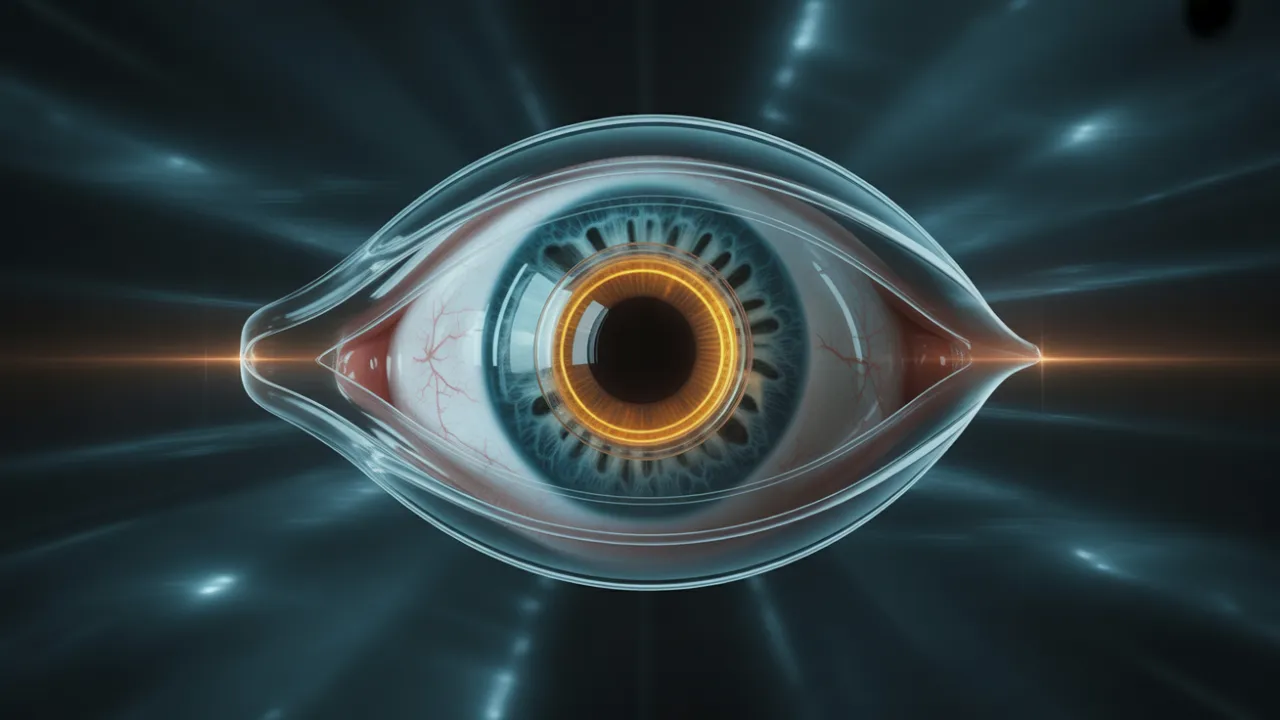
A new eye implant called the PRIMA system helped restore central vision in people with geographic atrophy, a severe form of age-related macular degeneration that causes blindness. After 12 months, patients showed significant improvement in their ability to see, offering hope for treating a condition that currently has no cure.
In this study involving 38 participants with geographic atrophy due to AMD, the PRIMA system restored central vision and led to a significant improvement in visual acuity from baseline to month 12. (Funded by Science Corporation and the Moorfields National Institute for Health and Care Research Biomedical Research Centre; PRIMAvera ClinicalTrials.gov number, NCT04676854.).
- 1The PRIMA system is a subretinal photovoltaic implant that can restore central vision in patients with geographic atrophy
- 238 participants with geographic atrophy due to AMD were included in the clinical trial
- 3Visual acuity improved significantly from baseline measurements to 12 months after implantation
- 4The study was funded by Science Corporation and registered as a clinical trial (NCT04676854)
Single-minus gluon tree amplitudes are nonzero
Imagine tiny particles called gluons are like spinning tops. Their spin can be in one of two directions, which physicists call 'plus' or 'minus'. For decades, the rulebook seemed to say that you could never have a situation where just one gluon was spinning 'minus' and all the others were spinning 'plus' — that outcome was thought to be zero. This paper found a loophole. Under very specific, purely mathematical conditions that don't exist in our physical reality but are useful for calculations, this interaction can happen. The researchers wrote down the exact recipe for it, fixing a small but important detail in our fundamental rulebook for how the universe works.
Sub-part-per-trillion test of the Standard Model with atomic hydrogen
Scientists made an incredibly precise measurement of light emitted by hydrogen atoms that tested one of physics' most fundamental theories - the Standard Model - to an accuracy of 0.7 parts per trillion. This measurement also resolved a long-standing disagreement about the size of protons by confirming the smaller value found in previous experiments with exotic atoms.
Rock art from at least 67,800 years ago in Sulawesi
Imagine finding a spray-painted handprint on a cave wall. Over thousands of years, a thin, glassy layer of minerals, like limescale in a kettle, grew on top of it. Scientists used a high-tech laser to analyze that mineral layer. By measuring the natural radioactive decay of elements within it, they figured out the layer is about 71,600 years old. Since the handprint is underneath that layer, it must be at least that old, with the most conservative estimate being 67,800 years. This makes it one of the oldest pieces of art ever found and proves that the early humans who lived on this Indonesian island, who had to cross the ocean to get there, were creating symbolic art.
An interstellar energetic and non-aqueous pathway to peptide formation
Imagine you have a box of LEGO bricks, which are like the basic molecules of life called amino acids. To build anything, you need to snap them together. Scientists used to think you needed a puddle of liquid water to make the bricks 'click'. This experiment is like discovering you can snap the LEGOs together inside a freezer. The researchers took the simplest amino acid, froze it onto a dust grain like you'd find in space, and zapped it with energy that mimics cosmic radiation. They found that the amino acids linked up to form a two-brick chain, the first step towards building a protein. This means the essential first chains for life could be forming all over space and delivered to new planets by comets and asteroids.